
Climate action
Climate action
In 2023 we committed ourselves to setting targets for reaching Net Zero emissions by 2050. In 2025, our targets have been validated by the Science Based Targets initiative (SBTi). The IRO’s found in our double materiality process are described in the following table.
| IRO description | IRO classification | Value chain |
| Scope 3 emissions make up the majority of all GHG emissions | Negative impact | Upstream, own operations, downstream |
| Ability to influence upstream and downstream value chain in achieving climate targets | Opportunity | Upstream, downstream |
| Greenhouse gas emissions will occur during production processes | Negative impact | Upstream, own operations |
| Sustainability as driver to reduce production costs through process efficiency and automation | Opportunity | Own operations |
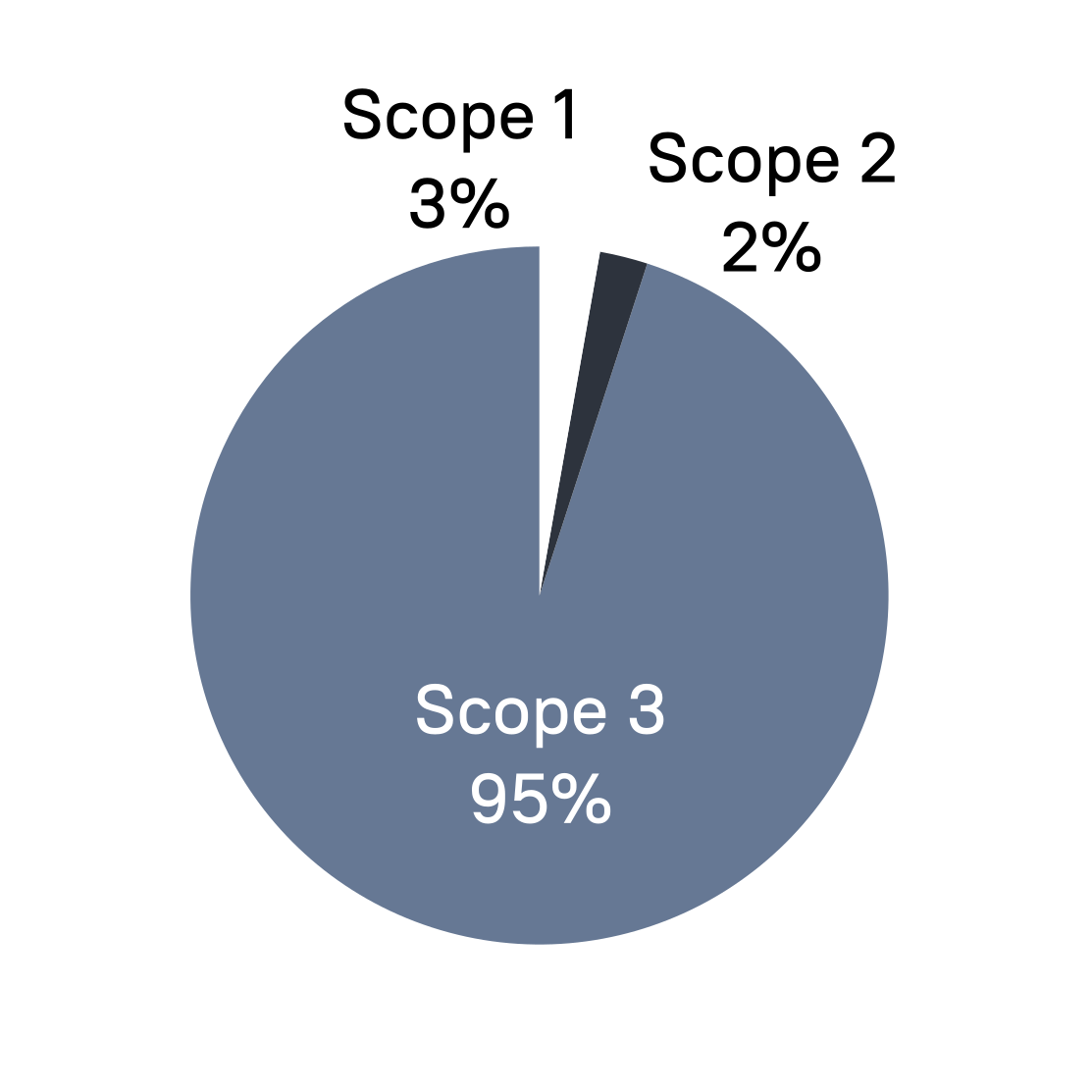
As for most companies, our scope 3 emissions are the majority of our greenhouse gas emissions. In 2025 97% of all our emissions are accounted for in scope 3 (compared to 95% in base year 2023).The majority of these emissions relate to material production for our own furniture, third party furniture and other products sourced for customers, non-product related spend (NPR) and transportation. And although greenhouse gas emissions will occur during production processes, there are also developments to reduce these through innovation, process efficiency and automation. Which ultimately also may result in reduced costs of operations.
Royal Ahrend has an opportunity to influence both the upstream and downstream value chain, because of our direct business model. In collaboration with our customers we can set climate targets for specific projects. Our international focus helps us to service global companies worldwide with the same expertise and products, scaling the environmental benefits. As a large furniture company in Europe we can create enough scale for most suppliers to influence their climate actions. Our focus on the value chain is crucial in climate change mitigation, because of our dependence on these stakeholders.
The responsibility for reaching our climate objectives lies with the Board of Directors, with delegated tasks to the sustainability team and key internal stakeholders like purchasing, sales and marketing. Departments and employees involved have set specific KPIs to contribute to these objectives. Corporate governance is explained in chapter 05 Leadership and governance.
Climate transition plan
In 2025 Royal Ahrend has finalised the climate transition plan in which our actions and milestones for short term (2030) have been determined to ensure progress in our reduction roadmap towards net zero emissions in 2050.
Our actions
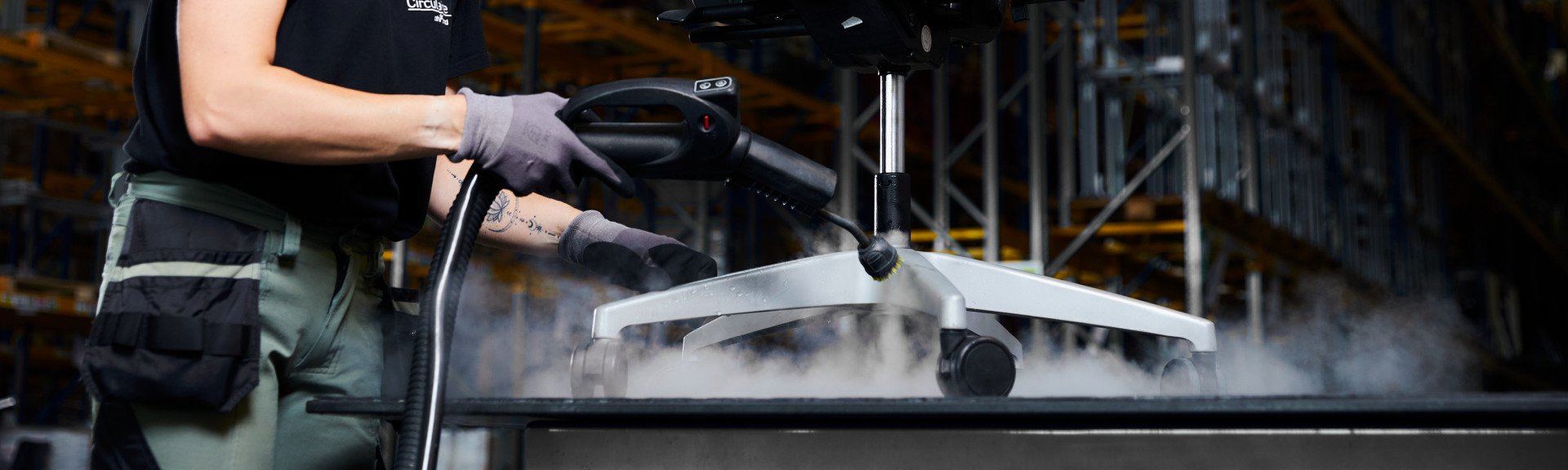
Our actions to reduce greenhouse gas emissions in scope 1, 2 and 3 focus on several projects. Primarily: the development of sustainable products and circular services to extend the product lifespan.
Sustainable products
Embodied carbon emissions
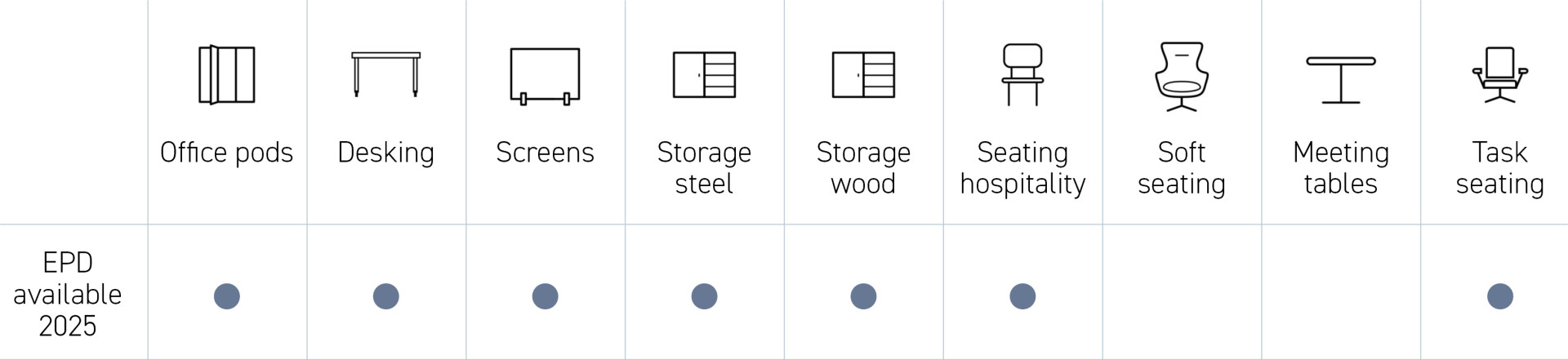
Since several years we are calculating the environmental impact of our furniture with lifecycle assessments (LCAs). In 2025 we calculated LCAs for various additional products, representing the majority of our product portfolio. We will improve our furniture designs compared to previous products following the Ecodesign principles. For desk chairs, desks and office pods we are have set specific reduction targets as part of our broader scope 3 emissions reduction commitment.
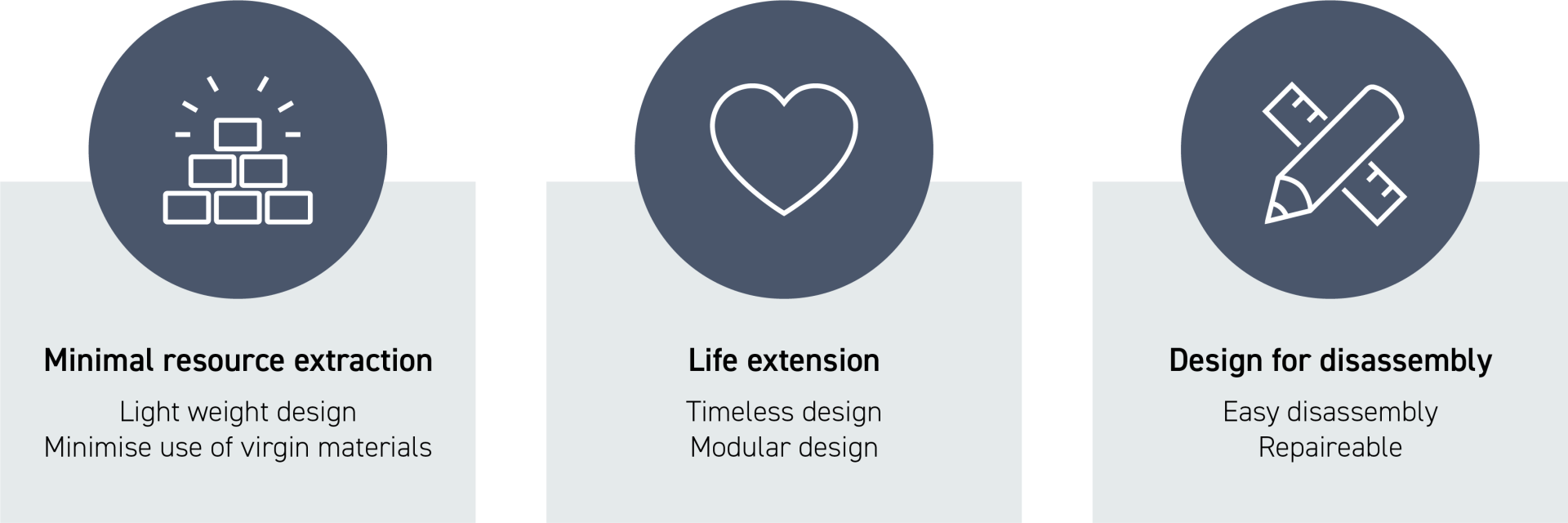
We have adopted the following design principles for new furniture: minimal resource extraction, life extension en design for disassembly. These design principles support our strategy to further grow our circular services. During the design and construction phase we calculate embodied carbon to ensure improvements in new furniture designs.
Circular services
As Royal Ahrend, we have further developed our circular business model and expanded our revenue yielding from these circular models. In the coming years, we are committed to increasing our share of circular services revenues and supporting more customers in achieving their workplace climate targets.
Circular consultancy
As in previous years, we continued working on professionalising our circular consultancy activities. Together with several customers we evaluated our furniture reuse quick scan and developed a scenario builder tool to support workplace decision making in line with climate targets. During the workspace design process we support our customers with options for refurbishment and reuse of existing furniture and available Revived furniture. With circular consultancy we are able to further grow circular workplace design together with our customers.
Revived
Revived is Royal Ahrend’s brand for previously used furniture that is ready for reuse by a new owner. These products pass through the same quality checks as newly produced furniture and receive a full warranty, ensuring the products are as good as new. In 2025, we optimised our insourced refurbishment activities by including data into our ERP system. Furthermore, in 2025 we continued industrialisation of furniture refubishment, enabling us to refurbish higher quantities and supply high-quality Revived products to our customers.
Furniture retrofit developments
Often furniture is discarded because the design, colour or function does not match current demands. Most furniture is discarded before reaching the end of its technical life. Therefore we are redesigning Royal Ahrend furniture that was designed several decades ago. For these products we are creating modular solutions that build on existing design components, while upgrading them to the latest standards. In 2025, we launched a new backrest for our A2020 desk chair series. With this development we support customers' sustainability goals, by reusing most of the product (by weight and volume), while meeting the latest ergonomic requirements.
Other actions in scope 1, 2 and 3
Our actions towards Net Zero in 2050 will be described in our climate transition plan. Over the past few years, we have set up an energy management plan according to ISO 50001 with yearly actions to reduce energy consumption and increase the share of renewable energy in our global operations. Our scope 3 action plan is to be finalised in 2025.
Scope 1 and 2
Royal Ahrend’s scope 1 and scope 2 emissions are 3% of our total emissions. In recent years, we have reduced scope 1 and 2 emissions by 74%, putting us on track to reach 85% reduction in scope 1 and 2 by 2030. Our year to year emissions reduced by 41%, from 5.092 CO2eq in 2024 to 3.024 CO2eq in 2025. This major reduction has been achieved by purchasing renewable energy for all of our operational electricity consumption. In the upcoming years we will further electrify our company vehicles and reduce energy consumption in our production facilities. With these actions, we are confident in reaching our 2030 goal.
Scope 3
In 2025, we calculated our scope 3 emissions for years 2024 and 2025. Through detailed supplier information, lifecycle assessments of our own product portfolio and spend analysis we were able to calculate our greenhouse gas emissions quite accurately. Although some Scope 3 emissions are still calculated using a spend-based method, this approach provides insufficient insight to effectively guide action. Therefore, in the coming year, it is important to obtain more activity-based data from suppliers.”
Transportation and logistics
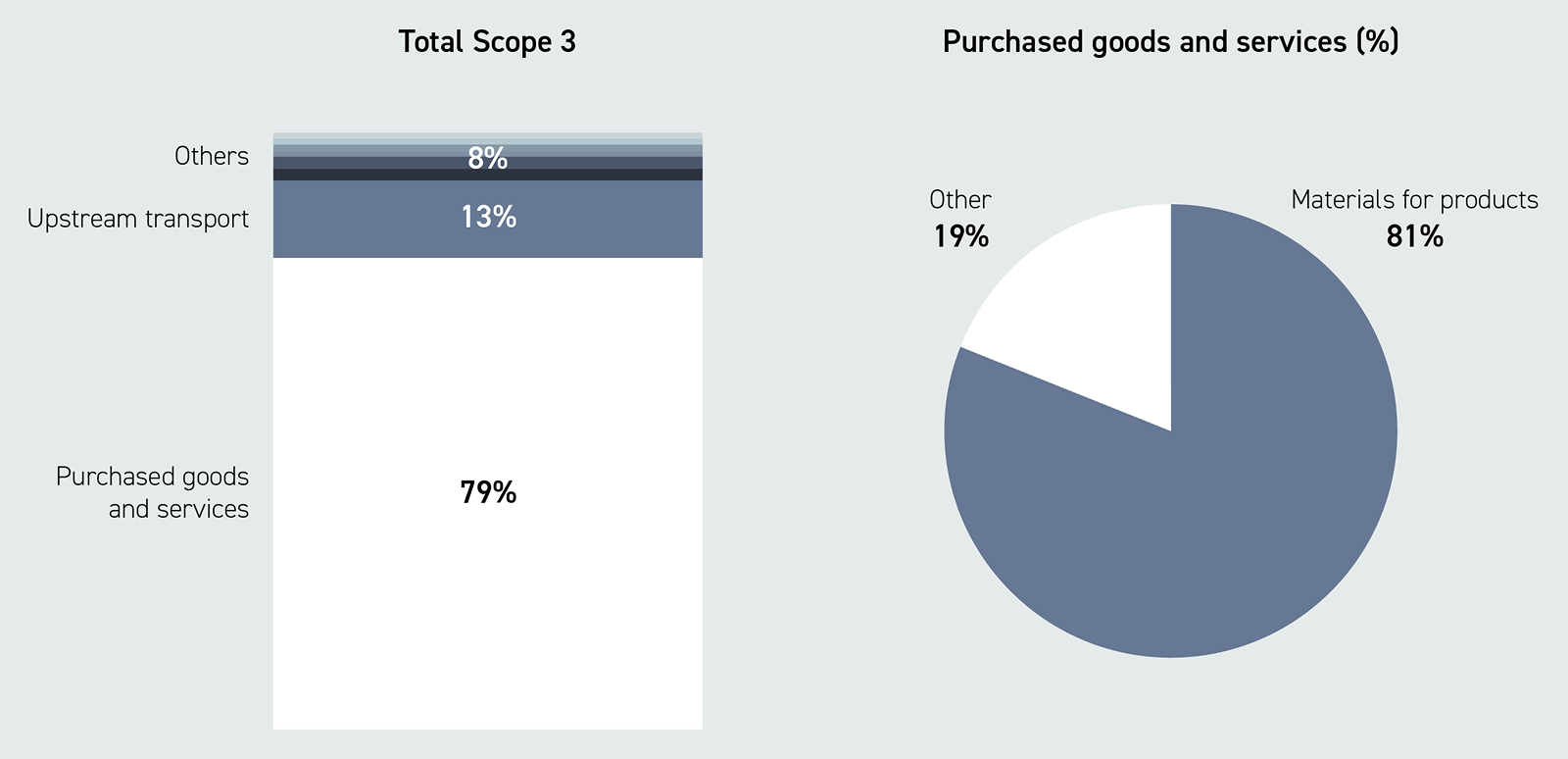
Upstream transport and distribution accounts for 11% of Royal Ahrend’s global emissions. Therefore we are expanding the share of electric trucks to deliver furniture to our customers. By the end of 2025 we had five fully electric trucks on the road and we will increase this share in the upcoming years.
Another action of importance is the improvement of First Time Right (FTR) deliveries. When we deliver complete, on time and without complaints we reduce unnecessary transportation. In 2025 we made progress in reaching our targets, but als in 2026 FTR deliveries remain a key priority for our company.
At this moment, approximately 30% of our mechanic vans are fully electric. The majority of our vans belong to the service department in the Netherlands. When vans are to be replaced, they will be substituted by electric vehicles.
Our targets and progress
Scope 1 and 2
By the end of 2025 our scope 1 and 2 emissions were 74% lower compared to our base year 2018. In this report we can restate our confidence in reaching 85% reduction by 2030, because of our solid climate transition plan. From 2025 onwards, all our global operations use solar and wind renewable energy through Guarantees of Origin. In the coming years, we will further reduce our Scope 1 and 2 emissions by electrifying our leased vehicles and promoting alternative commuting options.
Scope 3
Scope 3 emissions account for 97% of Royal Ahrend’s global greenhouse gas emissions. By 2030, we aim to reduce these emissions by 42% compared to 2023.
One of the key drivers behind reducing our scope 3 emissions is reducing the footprint of our furniture portfolio. Therefore we intend to calculate LCAs for 95% of our sales volume. These LCAs are externally verified for objectification. In 2025, 68% of our sales volume is covered by an Environmental Product Declaration (EPD) and this will gradually increase in the coming years. Older EPDs will be recalculated following EN 15804+A2.
A portion of our Scope 3 emissions is calculated using a spend-based methodology. Although total expenditure was lower in 2025 (compared with 2024), our reported Scope 3 emissions increased. This was particularly evident in Category 3.1 (Purchased Goods and Services), where reported emissions were 19% higher than the previous year. The increase is primarily attributable to an update of the Exiobase database in 2025. As a result, the underlying emission factors increased. For our overall scope 3 emissions this led to a 29% rise in the emissions per € spend. Consequently, higher emissions were calculated despite lower overall spending levels.
In 2026, we aim to transition further towards activity-based accounting methods. This approach will provide a more accurate representation of our emissions profile and better reflect the progress we are making towards our net-zero ambitions.
As outlined in our 2024 Integrated Report, we are increasing the share of electric heavy-duty vehicles used for customer deliveries and implementing more emission-free solutions. One of the initiatives we are exploring is a modal shift for long-haul transport. In 2024, we began using inland waterway barges between the Port of Rotterdam and our international warehouse in Veghel to reduce transport emissions. Additional alternatives for key transport routes are currently under investigation
Reduction development since 2018
This table shows the development of scope 1 and 2 emissions since base year 2018. Due to change in emission factor matching in 2023 the emissions may defer from data reported in prior Integrated Reports.
Bovenstaande grafiek in tabel-vorm:
| Year | Scope 1 and 2 emissions (tonne CO2eq) |
|---|---|
| 2018 | 11.550 |
| 2019 | 12.083 |
| 2020 | 8.877 |
| 2021 | 7.928 |
| 2022 | 7.433 |
| 2023 | 5.544 |
| 2024 | 5.079 |
| 2025 | 3.024 |
Path towards net zero by 2050
Royal Ahrend's reduction targets are currently under review by SBTi and are awaiting final approval. The graph below shows the proposed pathway towards net zero emissions by 2050.
Bovenstaande grafiek in tabel-vorm:
| Year | Emissions (tonne CO2eq) |
|---|---|
| 2023 | 99.264 |
| 2027 | 76.433 |
| 2030 | 67.500 |
| 2050 | 9.926 |
| KPI | 2023 | 2024 | 2025 | Target 2027 | Target 2030 |
| Total scope 1 emissions (tonne CO2eq) | 2.944 | 3.001 | 2.872 | ||
| 1.1. Stationary combustion | 2.057 | 2.121 | 2.328 | ||
| 1.2. Mobile combustion | 886 | 880 | 544 | ||
| Total scope 2 emissions (location based, tonne CO2eq) | 3.184 | 2.531 | 2.997 | ||
| 2.1. Use of electricity | 3.083 | 2.424 | 2.845 | ||
| 2.2. Use of heating | 100 | 107 | 152 | ||
| Total scope 2 emissions (market based, tonne CO2eq) | 2.600 | 2.078 | 152 | ||
| 2.1. Use of electricity | 2.500 | 1.971 | 0 | ||
| 2.2. Use of heating | 100 | 107 | 152 | ||
| Total scope 1 and 2 emissions (market based, tonne CO2eq) | 5.544 | 5.079 | 3.024 | 3.812 | 1.733 |
| GHG intensity scope 1 and 2 (tonne/€) market based* | 0,021 | 0,019 | 0,013 | - | - |
| Reduction in % compared to base year 2018 | -52% | -56% | -74% | -67% | -85% |
| Total scope 3 emissions base year (tonne CO2eq) | 99.264 | 86.172 | 90.293 | 76.433 | 67.500 |
| 3.1. Purchased goods and services | 78.532 | 60.062 | 71.340 | ||
| 3.2. Capital goods | 1.150 | 6.612 | 1.094 | ||
| 3.3. Fuel- and energy-related activities not included in scope 1 or scope 2 | 922 | 989 | 751 | ||
| 3.4. Upstream transport and distribution | 12.500 | 8.948 | 10.534 | ||
| 3.5. Waste | 221 | 116 | 30 | ||
| 3.6. Business travel | 618 | 622 | 426 | ||
| 3.7. Commuting | 1.473 | 2.940 | 2.998 | ||
| 3.8. Downstream transport and distribution | 2.763 | 246 | 148 | ||
| 3.11. Use of sold products | 761 | 2.827 | 670 | ||
| 3.12. End-of-life of sold products | 3.251 | 2.810 | 2.302 | ||
| GHG intensity scope 1, 2 and 3 (market based, tonne/€)* | 0,36 | 0,33 | 0,40 | ||
| Reduction in % compared to base year 2023 | - | -13% | -9% | -23% | -42% |
| Total energy consumption (mwh) | 7.989 | 6.933 | 8.268 | - | - |
| Increase share of renewable energy in own operations | 44% | 46% | 100% | 85% | 100% |
| Share of own furniture portfolio with verified LCA (EPD), based on total sales volume | - | 66% | 68% | 95% | 95% |
Internal carbon pricing
Royal Ahrend has not implemented internal carbon pricing. From experiences in the past years we see no additional value in implementing internal carbon pricing, because other mechanisms support sustainable investments in products, locations and services. This might change in the upcoming years and will be reported in future Integrated Reports.
Carbon removals and carbon credits
In recent years, Royal Ahrend purchased carbon removals for emissions generated by process heating. Since we are working towards new targets in 2030 and 2050, we decided to reevaluate this approach. The role of carbon removals and carbon credits in our road towards net zero will be included in our Climate Transition Plan. This plan is currently under development.
EU taxonomy
Royal Ahrend is not eligible for EU taxonomy. There are no objectives or plans to report taxonomy alignment at this moment.
Changes to prior years
Scope 1 and 2 emissions over the period 2018-2023 have been recalculated due to a change in emission factors. This change resulted from a software change which includes additional databases with more accurate data per region. Our base year 2018 has been recalculated and percentages in the table above correspond to the latest calculations.
| Year | Scope 1 and 2 emissions (market based, CO2eq) reported in prior reports | Revised scope 1 and 2 emissions (market based, CO2eq) |
| 2018 (base year) | 13.250 | 11.550 |
| 2019 | 12.666 | 12.083 |
| 2020 | 8.725 | 8.877 |
| 2021 | 8.689 | 7.928 |
| 2022 | 7.949 | 7.433 |
| 2023 | 5.715 | 5.544 |