
Resource use and the circular economy
Resource use and the circular economy
At Royal Ahrend we have been committed to the circular economy for a long time. What started with making products for easy disassembly in the 1990s, has grown into a circular business model that includes a service portfolio that supports the lifecycle extension of products. When it comes to furniture production, we are committed to using as little material as needed and using as much recycled content as possible. Furthermore, we are rapidly scaling our circular services model to support our customers in their journey to becoming more sustainable. The IROs found during our double materiality process are described in the table below.
| IRO description | IRO classification | Value chain |
| Demand for virgin materials poses risk on the environment and exhausts natural resources | Negative impact | Upstream, own operations |
| Substitute virgin materials with high quality recycled and other innovative materials, while assessing circular pathways for materials without pollutant exposure after recycling | Opportunity | Upstream, own operations |
| Recycled and other innovative materials are more expensive than virgin alternatives and cause price increase for final products | Risk | Upstream, own operations, downstream |
| Reduce environmental impact through circular product design and scaling circular services model | Positive impact | Upstream, own operations, downstream |
| Growing demand for circular services to extend product lifespans | Opportunity | Upstream, own operations, downstream |
| Scalability of Revived proposition is dependent on availability of take-back stock on the market | Risk | Upstream, own operations, downstream |
Our actions
Our actions in relation to resource use and supporting the circular economy are covered in three projects: the development of sustainable products, expansion of our circular services portfolio and climate action within our own operations. Actions to reduce the use of virgin resources have also lead to a reduction in scope 3 emissions. It is for this reason that some topics are already covered in the previous chapter.
Sustainable products
As a manufacturing company, we are committed to reducing the environmental impact of our furniture designs while delivering valuable workplace solutions to our customers and users. From Life Cycle Assessments (LCAs) of our product portfolio we know that approximately 75% of the footprint originates from material production. Therefore, we are actively involved in selecting materials with a low embodied carbon footprint.
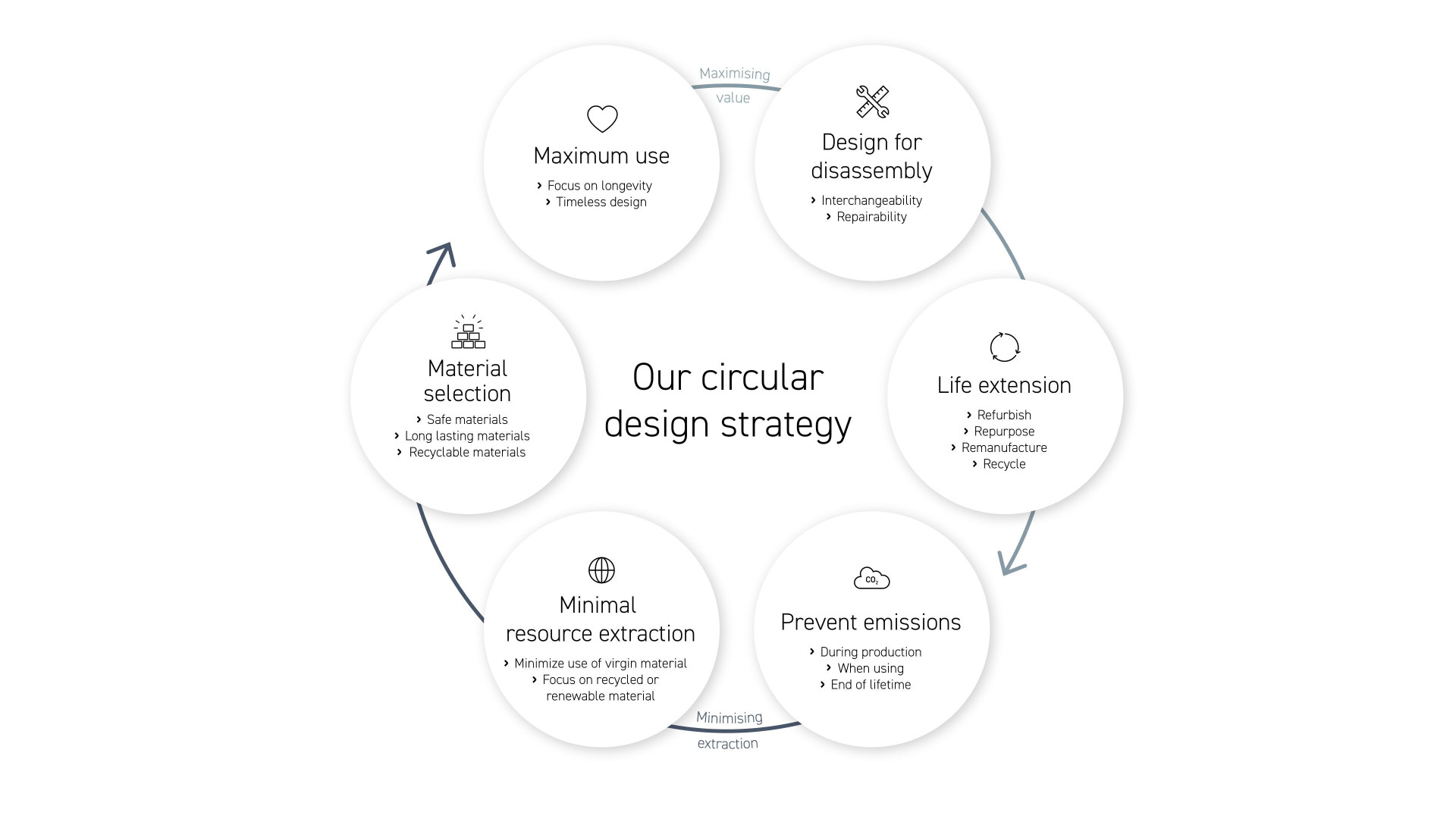
Circular design framework
Royal Ahrend’s circular design framework focuses on both a product and material level. In our design framework we incorporate four circular economy strategies:
- Regenerate: clean materials, suitable for high quality and safe recycling. We approach this with Cradle to Cradle Certified® requirements.
- Narrow: use fewer natural resources in our operations and furniture designs. By calculating the environmental footprint through an LCA, we know what material choices to make during the design process.
- Slow: keep reusing materials and extend the lifespan of our furniture. Furniture is always designed with the end of its first use in mind, because we want to extend the lifespan after this first cycle, ensuring fast and easy refurbishment opportunities.
- Close: recycle materials at highest possible level to keep materials in use. During design we ensure that our materials can be recycled and we research end of life strategies to incorporate these materials into our new products.
Material innovation
According to the Circularity Gap report 2025, only 6,9% of all materials used globally come from recycled streams and only 11% of all materials flowing out of the economy are recycled. Therefore, we focus on turning waste materials into furniture by incorporating more post-consumer recycled materials. In 2025 we successfully integrated more recycled steel in our Qabin office pods, increasing the share of 16% to 50% post-consumer recycled content. Furthermore, we launched the A2020 Luvia backrest with post-consumer recycled plastics.
Since we take back a lot of furniture, we also generate some plastic waste from used products during the refurbishment process. In 2025 we participated in a research project to estimate the recycling potential for plastics with glass fibre. The next phase includes a pilot in collaboration with suppliers to evaluate the quality of the recycled material. This pilot is scheduled for 2026.
Material safety
At Royal Ahrend we work according to the Cradle to Cradle Certified® principle that materials have to be safe in order to be circular. This contributes to our customer focus and promise to deliver furniture with healthy and safe materials. In 2025 have been working on re-certification of our mejor product lines under the Cradle to Cradle Certified® programme. The certificates are expected to be published in H1 2026. In the upcoming years we are expanding the Cradle to Cradle Certified® requirements to suppliers of other raw materials and parts.
Sustainable material flows
In 2025, we mapped our material flows, so we can report them both internally and externally. Due to a company wide ERP implementation project, we have decided to externally report our material flows when data quality of all entities is aligned in our new ERP system. Our primary focus is on improving the environmental footprint of steel parts, wood parts and plastics. We are seeking collaboration with material suppliers to gain insight into the post-consumer recycled content in our materials and to identify improvement areas.
By the end of 2025, the European Commission published a delay of the European Deforestation Regulation (EUDR). The goal of this regulation is to ban products from the European internal market that cause deforestation. In addition to purchasing wood from certified sustainable sources, we will have to process additional data. Royal Ahrend and suppliers have to comply to EUDR by the end of 2026.
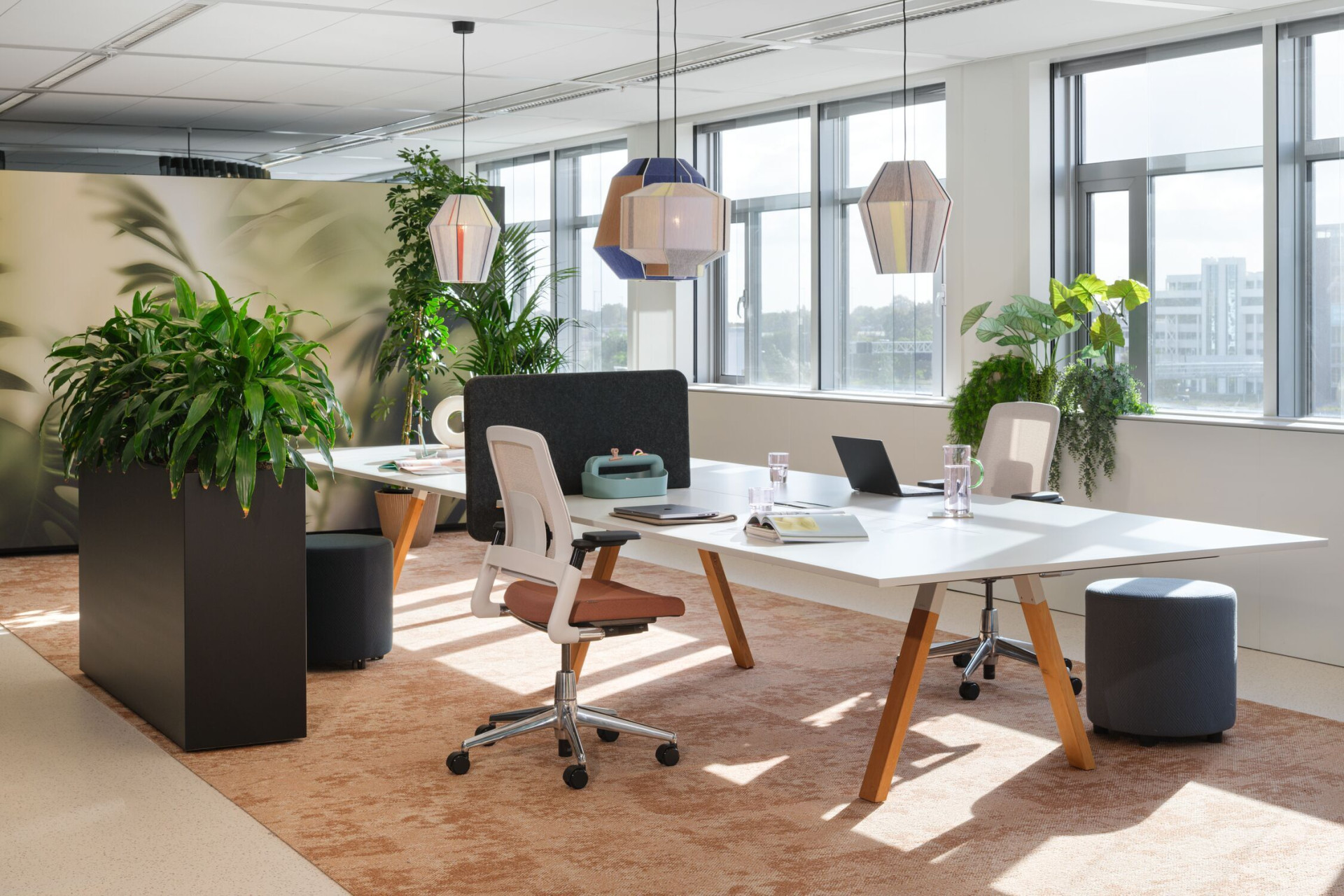
Ahrend 2020 Luvia; designed to move with the needs of today and tomorrow
This renewed chair combines smart, modular design with a strong focus on sustainability. By introducing the new Luvia backrest, the Ahrend 2020 chair is given a contemporary look and improved functionality, while extending the life of an existing product platform. The A2020 is Cradle to Cradle Certified® Gold and is made from 50% recycled materials. Thanks to its modular construction, parts can be replaced or renewed, supporting reuse, repair and a longer product lifecycle.
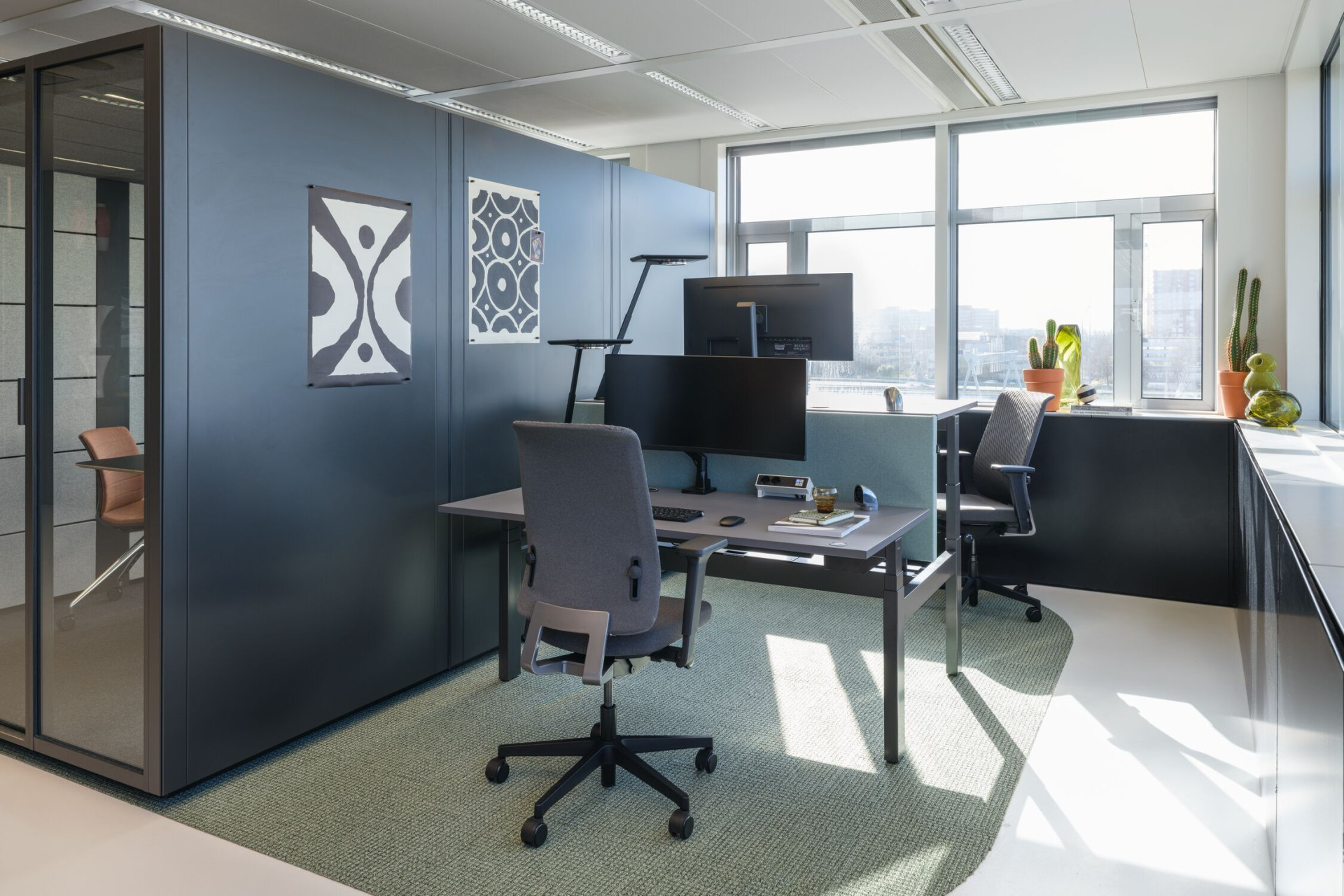
Ahrend Ease Shapeknit brings comfort, quality and sustainability together
The new removable knitted cover for the Ahrend Ease task chair collection is made from 100% recycled PET and is produced with virtually no material waste. The distinctive knitting pattern gives the sleeve a premium look and feel, while the integrated pads enhance comfort for the user. By using recycled materials and a production process that reduces waste, Shapeknit supports a more responsible and resource-efficient way of designing workplace furniture.
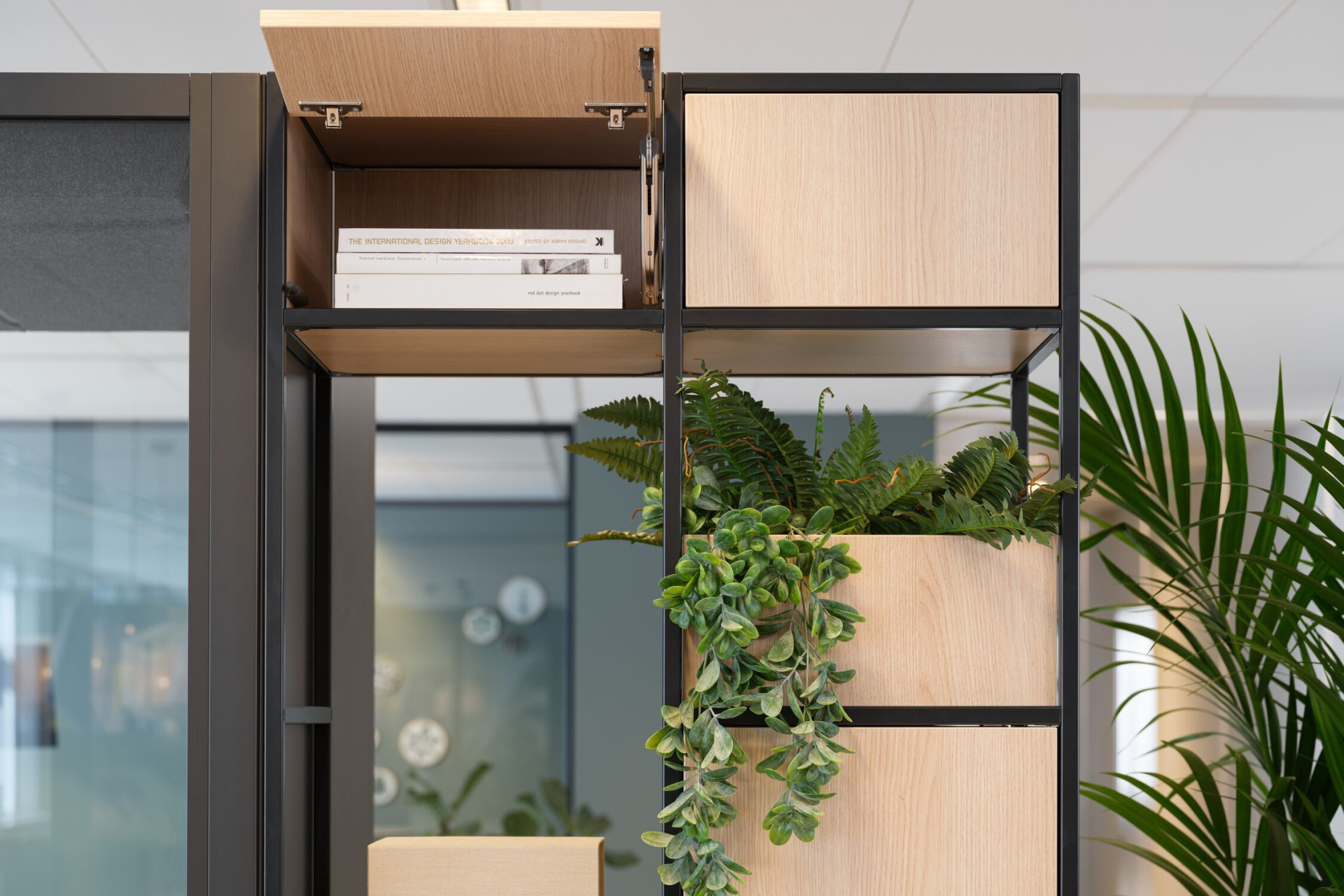
Ahrend Alvido is developed according to circular design principles and built to last for multiple lifecycles
Its modular design makes components easy to repair, replace, reuse, and recycle, helping to extend both the lifetime of the cabinets and the materials used. The patented connection system supports long-term durability and makes future disassembly, reuse and recycling easier. In this way, Ahrend Alvido contributes to a circular workplace environment in which products retain their value for as long as possible.
Circular services
With the expansion of our circular services we can extend the product lifespan while reducing the carbon footprint of workspaces. We see a growing interest from our customers in our circular services due to maturing sustainability practices which demands transparency and accurate data to report reduction targets. With our focus on minimising the use of resources and our services portfolio, we support our customers in reaching their sustainability goals.
Circular hub
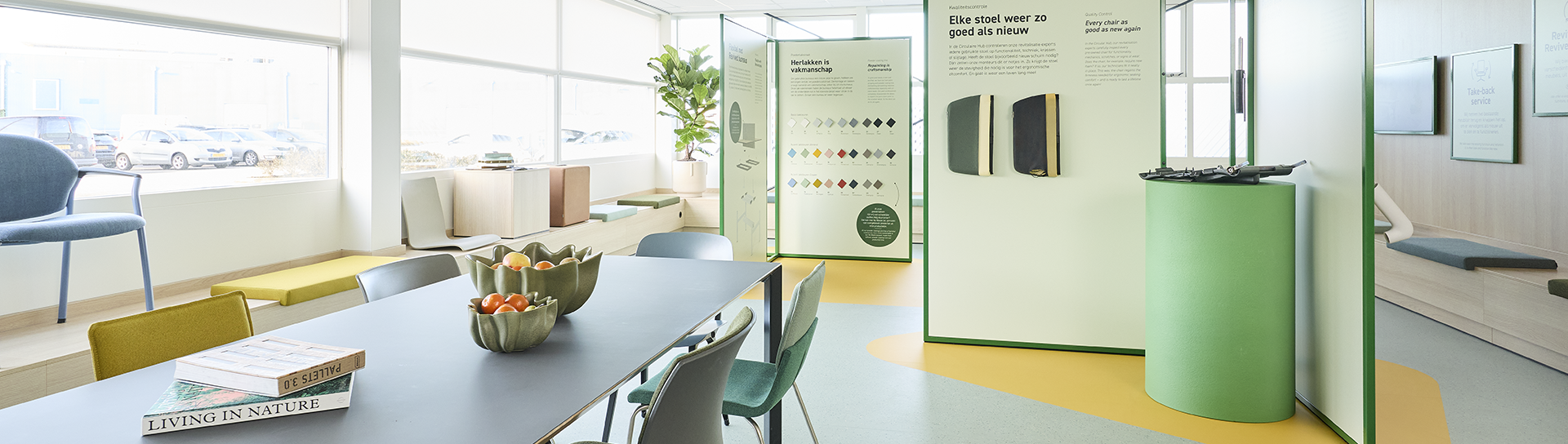
Since the opening of our first Circular Hub in 2021, we have experienced rapid growth in all our markets. After initially focussing primarily on the Dutch market, we have adopted an international growth strategy. In the upcoming years we will first focus on further expanding our business to other Western European countries.
As a result of both growth and further refurbishment activities we have expanded our production floor from 6.000 m2 to 8.000 m2. In 2025, we further strengthened our circular capabilities by establishing an integrated refurbishment process for chairs in Sint-Oedenrode. This new setup combines refurbishment and new production activities into a single process, ensuring continuity, efficiency, and consistent product quality. Looking ahead, we will extend this approach by relocating workplace refurbishment activities from Veghel to Sint-Oedenrode in 2026.
Since 2023, we refurbished 174.049 pieces of furniture in the Circular Hub.
In the upcoming years we are focusing on getting more feedstock furniture back from the market. We are currently establishing new partnerships with other furniture manufacturers to grow towards an industry-wide collaborative approach for refurbishment. This results in high-quality refurbished products with a warranty, original parts and global coverage to refurbish locally.
Services portfolio
Royal Ahrend’s business model is changing rapidly from a furniture manufacturer to a workplace service provider. Our unique approach that uses direct sales channels, provides us with the opportunity to make this shift and orchestrate furniture flows. As a result, we form closer relationships with our customers, are able to secure material flows, realise lower setup costs and make faster deliveries to our customers.
Climate action
We are taking climate action through responsible production practices, including waste management and water management at our production locations.
Waste management
Waste management has been a priority for us since the early 1990s. In total we separate 22 types of waste in our factories with the majority being wood (51%), steel (16%), paper and cardboard (8%). As for previous years, most wood waste was produced by our factory in Czech Republic. In 2022, we implemented a closed loop take back system for wood residues with a supplier from our Wood Hub in Czech Republic, resulting in 97% less wood waste. We established a circular system for several wood packaging materials, increasing the share of reused materials to 15%. All steel scrap is transported for recycling and originates mainly from our metal hubs in the Netherlands (Sint-Oedenrode) and China. In 2025 and 2026 we focus on reducing waste from packaging materials.
Water management
All production facilities consume water, but most of our water consumption is related to our metal departments in the Netherlands and China and wood hub in Czech Republic. Process water is powder coating metal parts. All water used is sourced from local suppliers of tap water. Waste water is always neutralised before being discharged and the quality is tested frequently by independent parties under regional regulation to prevent water pollution.
Our targets and progress
In 2025, we have made great progress in gathering valuable supplier data to strengthen our circular materials planning. We focus on using as much post-consumer recycled materials as possible. We have not set targets for all KPIs, because we want to monitor developments, but at the same time focus on projects with high impact. This is indicated in the table below.
Sustainable products
Our internal Lifecycle Management (LCM) process for new product developments includes a standardised set of sustainability requirements to improve the sustainability performance of our products. During the product development process we model LCA studies to assess the effects of our material choices. We have made great progress in incorporating this in our standard way of working.
For newly launched products we have incorporated more recycled plastics. By modelling the environmental effects with LCA during the product development process we were able to determine the most sustainable solution. Recycled plastics remain high on our priority list in upcoming years.
In 2025, we have added more recycled steel and have investigated strategic partnerships with energy efficient steel manufacturers. Furthermore, we are exploring sustainable glass alternatives for our space-in-space solutions.
Circular services
The share of circular services as part of Royal Ahrend’s total revenues is growing gradually. By late 2025, we had €19,86 mln of leased assets in the market, a 4% increase compared to the previous year. In 2025, we invested €2,35 mln in Furniture as a Service assets, while €1,64 mln was divested following sales to customers or the Circular Hub. Divestments were relatively high due to several large contracts reaching maturity, resulting in more moderate net asset growth for the year 2025.
Service revenues did not develop as expected in 2025. The decline in overall company revenue was also reflected in lower service revenues, resulting in growth below our forecast. As market demand is expected to recover in the coming years, we are investing in strengthening and expanding our service offering to support sustainable and profitable growth.
Despite these market conditions, revenues from our circular services remained stable. These services include circular consultancy, refurbishment and the sale of Revived products. In the coming years, we will continue to expand our circular service portfolio, enabling customers to extend product lifecycles and maximise the value of existing furniture.
Climate action
Waste management led to 22 separate waste types in 2025. 8% of all production waste was reused and 38% recycled, 52% was used for energy production and 1% ended up as waste. Our production waste decreased a lot since 2024 due to closed loop recycling solutions for wood waste from our wood hub in Prague. As a result our total production waste reduced by 41% since 2023.
We have invested a great deal in our waste management activities to make sure that we avoid hazardous waste in our production process, resulting in 1% hazardous waste in 2024, including materials contaminated with oils, varnish, paints and sludge from water treatment. No targets have been identified for water consumption or water treatment.
| KPI | 2023 | 2024 | 2025 | Target 2027 | Target 2030 |
| Product launches according to our circular design framework | 100% | 100% | 100% | ||
| Number of products cycled through Circular Hub | 68.000 | 66.740 | 39.309 | - | - |
| Share of Revived products of own product revenues | 5% | 4% | 20% | ||
| Circular services revenues | €10,1 mln | €12,46 mln | €9,34 mln | €20 mln | * |
| Furniture as a Service assets in the market | €17,02 mln | €19,15 mln | € 19,86 | €27,2 mln | €34 mln |
| Total waste (tonne) | 2.601 | 3.249 | 1.540 | - | - |
| Total hazardous waste (tonne) | 48 | 40 | 13,4 | Uphold <50 | Uphold <50 |
| Reused waste | 1% | 4% | 8% | - | 80% reused or recycled |
| Recycled waste | 71% | 67% | 38% | - | |
| Energy production from waste | 25% | 26% | 52% | - | - |
| Non recycled waste | 4% | 4% | 2% | Uphold <5% | Uphold <5% |
| Water withdrawal (surface and tap, m3) | 13.350 | 13.090 | 12.071 | - | - |