
Customers and end-users
Consumers and end-users
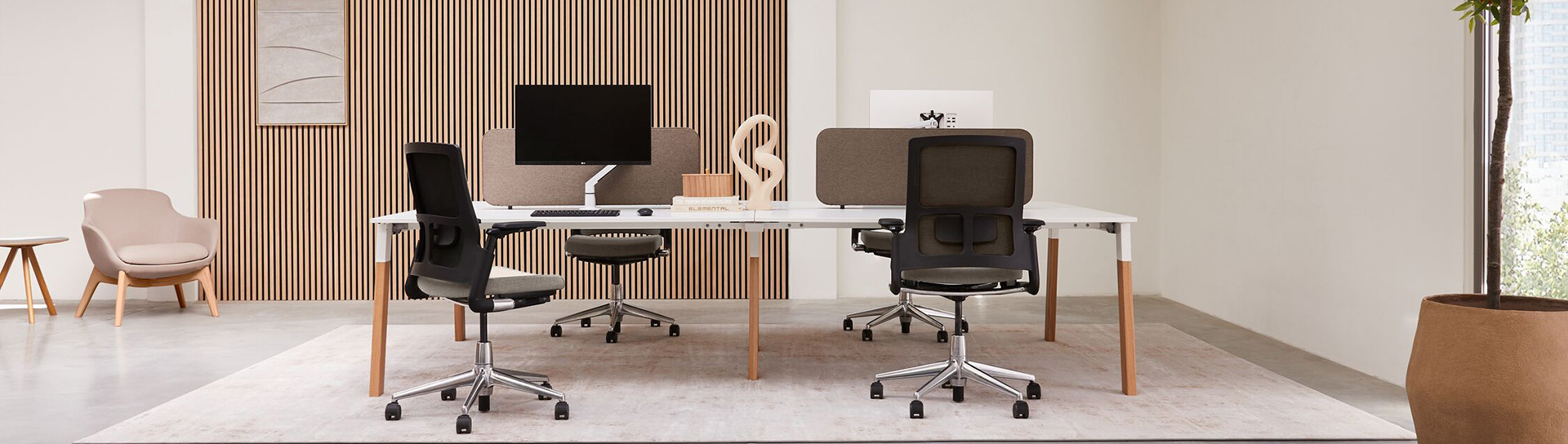
All our products and services are developed with the user in mind. And since most of our furniture users do not procure these products themselves, we are committed to creating ergonomic and adaptable furniture that supports a healthy working posture – either at the office or at home. Royal Ahrend offers a sustainable, durable and healthy workplace solution for each furniture product category. The IRO’s found during our double materiality process are described in the following table.
| IRO description | IRO classification | Value chain |
| Ergonomic and adaptable furniture supports healthy working posture for office workers at their (hybrid) working environment | Positive impact | Downstream |
| Materials may be a pollutant source affecting indoor air quality and thereby the health of office workers | Negative impact | Downstream |
| Enhance user health by incorporating proper ventilation, sound absorption and lighting in office pods | Positive impact | Downstream |
| Research and adopt innovations to improve user health and wellbeing at work environments | Opportunity | Downstream |
Our actions
As we are committed to create vitalising workspaces for our customers. We prioritise ergonomics and good indoor air quality for healthy working environments. Our products comply with requirements from building certifications such as LEED and WELL. Research shows that certain materials may affect the indoor air quality and thereby the health of office workers. Through our circular design principles we have standardised user health in our furniture designs.
With a growing demand for space in space solutions, we promote good indoor air quality with the right levels of ventilation, but also high performance in terms of sound absorption and lighting.
Ergonomics and accessibility
All our furniture is designed to be used by a wide variety of people. That’s why it’s important that our furniture is intuitively adjustable by each user. As our furniture is used throughout the entire workday, it must meet international standards for ergonomics and durability. Our in-house test laboratory allows us to thoroughly test each product before it goes to market. Before launch, we always work with external testing institutes to validate our in-house results.
Our customers aim to create diverse workspaces that are also accessible for people with physical limitations. We ensure our product designs consider physical accessibility. The Qabin collection features a wide door, for example, making it accessible for wheelchair users.
Acoustics
We pay close attention to material choices in our products. For individual items, this means selecting sound-absorbing materials where needed. In addition, the overall workspace design plays a key role in achieving the right acoustic balance—by combining materials that differ in sound absorption levels. Our interior studio advises customers on furniture layout, interior design, and material selection to create the desired acoustic environment.
Indoor air emissions
The quality of our furniture is an important aspect of our market proposition. Since our furniture is designed to be used indoors, we want to make sure that materials are low on volatile organic compounds (VOCs). To ensure that products are healthy and safe for indoor use, we test our products on indoor air emissions in test chambers.
Our furniture has to comply with the highest standards for furniture, meaning that the applied materials are low on VOCs. Healthy indoor air is an important factor for creating healthy workspaces and is increasingly important to our customers who focus on employee health, well-being and productivity. This is in accordance with the LEED and WELL building certifications.
Space in space solutions
For our space-in-space solutions, it is especially important to design with the right lighting in mind. Our space-in-space solutions feature a variety of integrated lighting systems, for example biodynamic lighting that adjusts with natural daylight to create the feeling of being outdoors, even when inside the pod. Users can also dim the lights to their personal preference throughout the day.
Acoustics are another key element. Our Qabins are designed to meet the highest international standards for sound insulation. These acoustic qualities are independently tested to ensure that users can have quiet, private meetings without disturbing others in the workspace.
Indoor air quality is also increasingly important, as customers increasingly notice differences between products on the market. We have invested heavily in a silent ventilation system for Qabin. It provides continuous airflow, creating a cool breeze while silently refreshing the air inside. This balances both perceived temperature and actual CO₂ levels, making the space comfortable throughout a meeting. Users can control the ventilation level to suit their preferences, giving them a sense of comfort and control inside the pod.
Emotional durability
We design product components to meet new standards, extend the lifespan of older products and support emotional durability. Furniture is often discarded long before it is worn out. In many cases, the main structure remains in good condition for many more years, but the component no longer fits current needs or preferences. This is why we develop our furniture to be as modular as possible, allowing individual components to be easily replaced.
We are currently designing new components for outdated furniture lines. This enables us to reuse the main components while giving the furniture a fresh look and feel that matches today’s standards. This is how we extend the lifespan of older furniture and reduce unnecessary waste. In 2025, we launched a redesign of the A2020 desk chair, the A2020 Luvia. The new backrest of this chair meets the latest ergonomic standards while keeping the majority of the existing chair in use. This enables customers to only replace a part of the chair while reusing most of the previous chair.
Our targets and progress
New furniture designs follow a design and development process with standardised requirements, including ergonomics, environmental performance and adaptability to specific needs. Innovation and research is an important aspect in creating tomorrow's workspace designs. In these workspaces we also want to reuse products already in use.
In 2023, we standardised our supplier requirements based on the Cradle to Cradle Certified® Basic Level criteria. 29% of our suppliers (measured by spend) meet these requirements, helping us ensure that our products are free from hazardous substances. This percentage remained unchanged compared to 2024. We aim to increase this to 60% of our supplier spend by 2027.
To ensure healthy indoor air quality, we test our furniture according to the ANSI/BIFMA e3 7.1 furniture sustainability standard. By the end of 2025, 61% of our own product sales complied with this standard. Although this percentage decreased compared to 2024, we are still on track to reach 95% compliance by 2027 as laboratory tests are currently being perfomed.
Product innovations
Developments of our space-in-space collection are moving quickly, with a strong focus on technical and modular innovations over the past year. Research shows that lighting impacts mood and wellbeing. This is why we have tested new lighting features for our space-in-space collection and lanched Skylight in our Cerene office pod collection. Skylight brings the sensation of daylight indoors, even in windowless spaces. Integrated into the ceiling is the innovative Signify NatureConnect lighting solution, which simulates natural daylight. This results in a bright, spacious atmosphere that feels like sitting under a skylight with a view of a clear blue sky.
We continue to improve the modularity of our products to extend their lifespan and support circular use. In 2025, we introduced Shapeknit, a removable knitted cover for the Ahrend Ease desk chair series. The back panel is designed for tool-free disassembly, requiring no screws, staples or glue. This innovation reflects our circular design principles by enabling customers to refresh the chair's appearance without replacing the entire product. By designing for emotional durability, we help keep products in use for longer and reduce the need for premature replacement.
In 2025, we also launched the Ahrend Alvido: a modular cabinet system that can be configured to individual specifications. All materials and components can be easily adjusted, making the system easy to disassemble and reassemble in a different form without unnecessary waste. The cabinet system won a Red Dot Award and was developed entirely according to circular principles.
| KPI | 2023 | 2024 | 2025 | Target 2027 | Target 2030 |
| Share of material and parts suppliers compliant with Cradle to Cradle Certified basic requirements (based on total spend) | - | 29% of total spend | 29% of total spend | 60% of total spend | 95% of total spend |
| % of own product sales compliant with highest standard Ansi/Bifma M7.1 furniture sustainability (e3) | 30% | 72% | 61% | 95% | 95% |